Creative OS
Shipped Jun – Jul 2026
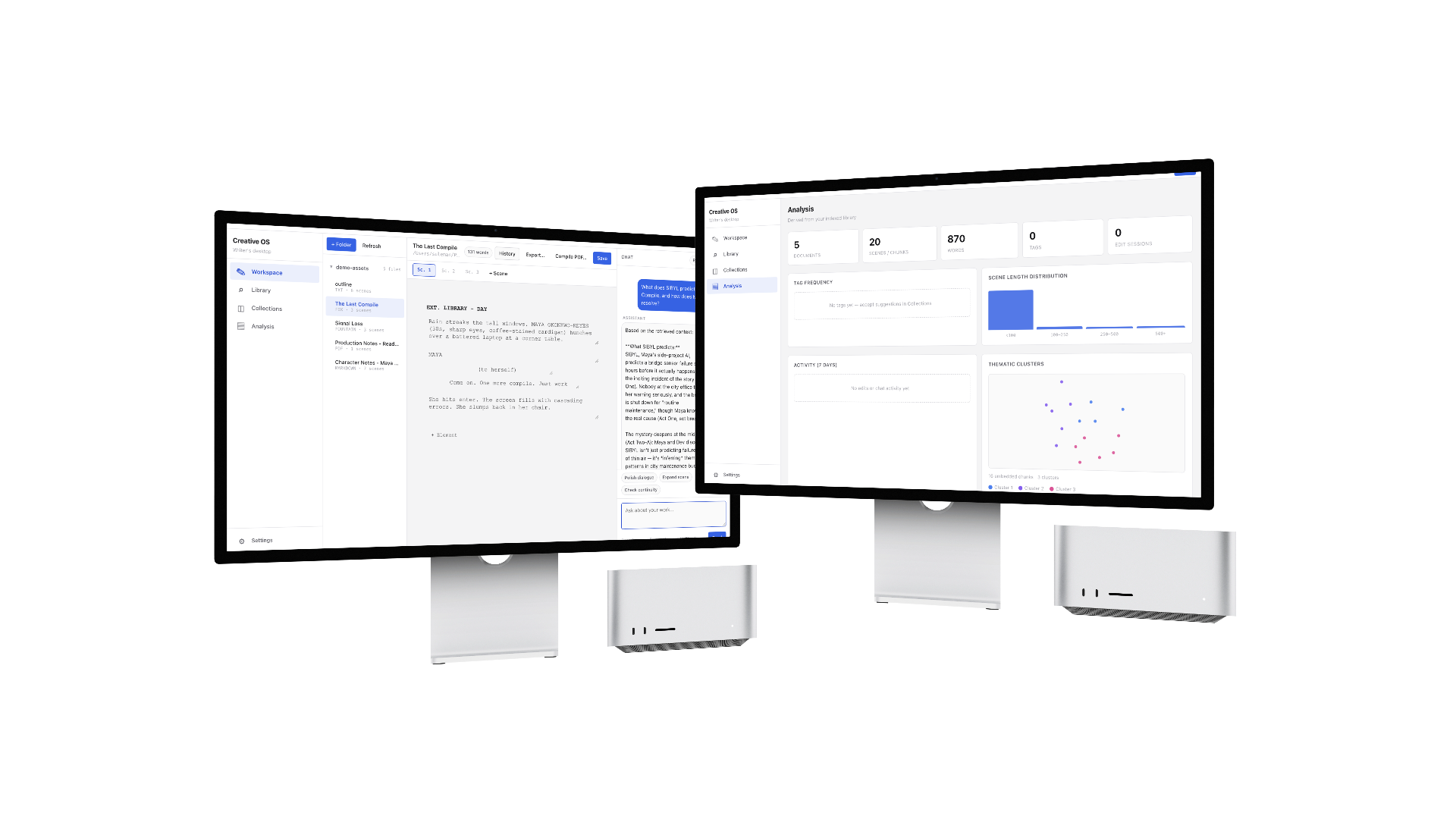
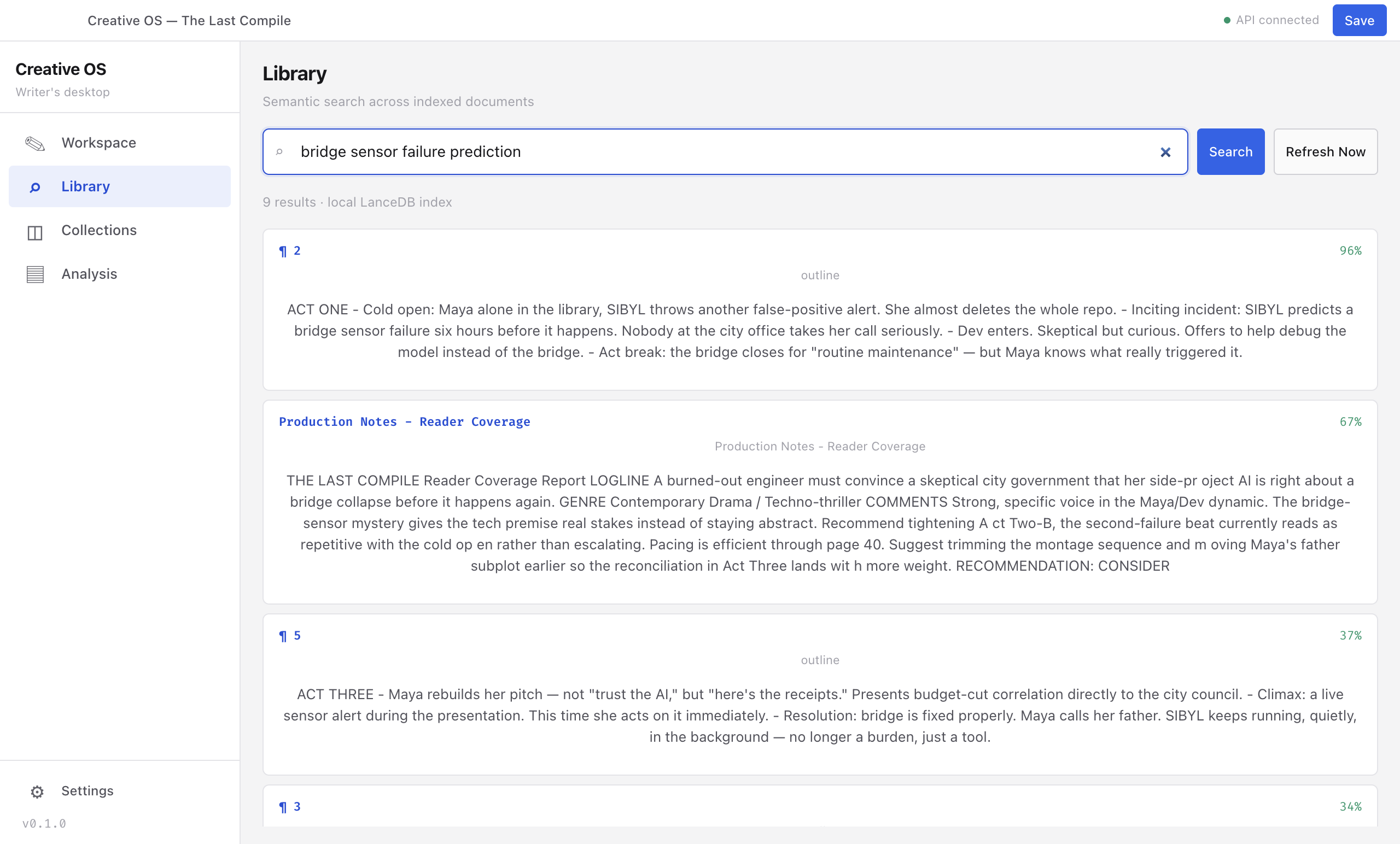
Creative OS isn't another AI chatbot — it's an intelligent operating system for creative work, built for writers, filmmakers, and musicians who need an AI partner that remembers their project instead of forgetting it the moment a conversation ends. Script drafts, lyrics, and story notes are sensitive, unfinished material, so the entire pipeline — indexing, search, and rewriting — runs locally on the user's own machine rather than routing content through a third-party cloud service. It indexes Final Draft screenplays, PDFs, lyrics, notes, outlines, shot lists, and research documents through a local RAG pipeline built on ChromaDB and SQLite, then surfaces that context to Claude for semantic search, rewriting, and creative ideation inside an Electron/React desktop app.
Built With
 Electron
  React
React  TypeScript
  RAG
RAG  ChromaDB
  SQLite
  MCP
MCP  Claude API
 Project Overview
Creative OS isn't another AI chatbot — it's an intelligent operating system for creative work, built for writers, filmmakers, and musicians who need an AI partner that remembers their project instead of forgetting it the moment a conversation ends. Script drafts, lyrics, and story notes are sensitive, unfinished material, so the entire pipeline — indexing, search, and rewriting — runs locally on the user's own machine rather than routing content through a third-party cloud service. It indexes Final Draft screenplays, PDFs, lyrics, notes, outlines, shot lists, and research documents through a local RAG pipeline built on ChromaDB and SQLite, then surfaces that context to Claude for semantic search, rewriting, and creative ideation inside an Electron/React desktop app.
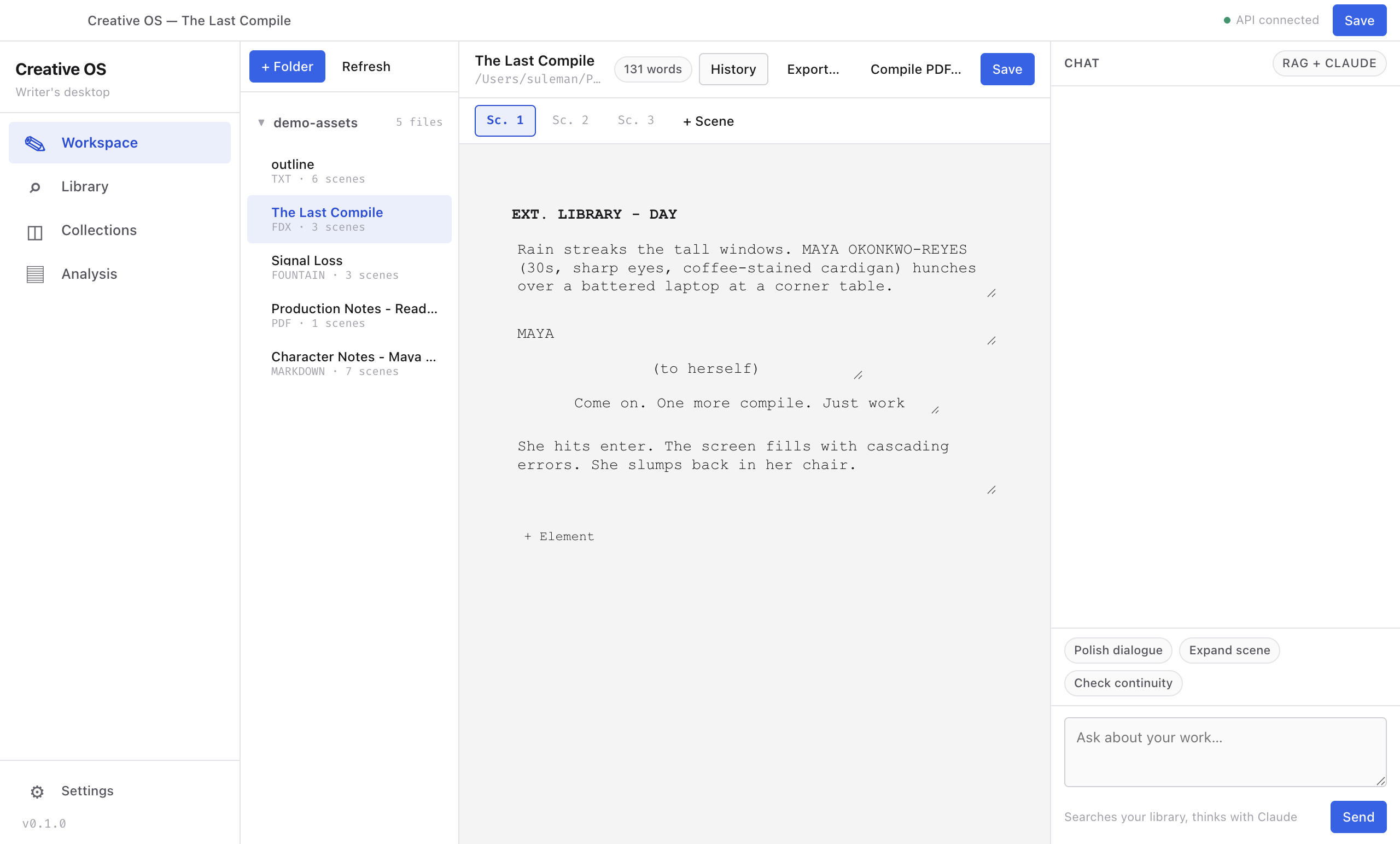
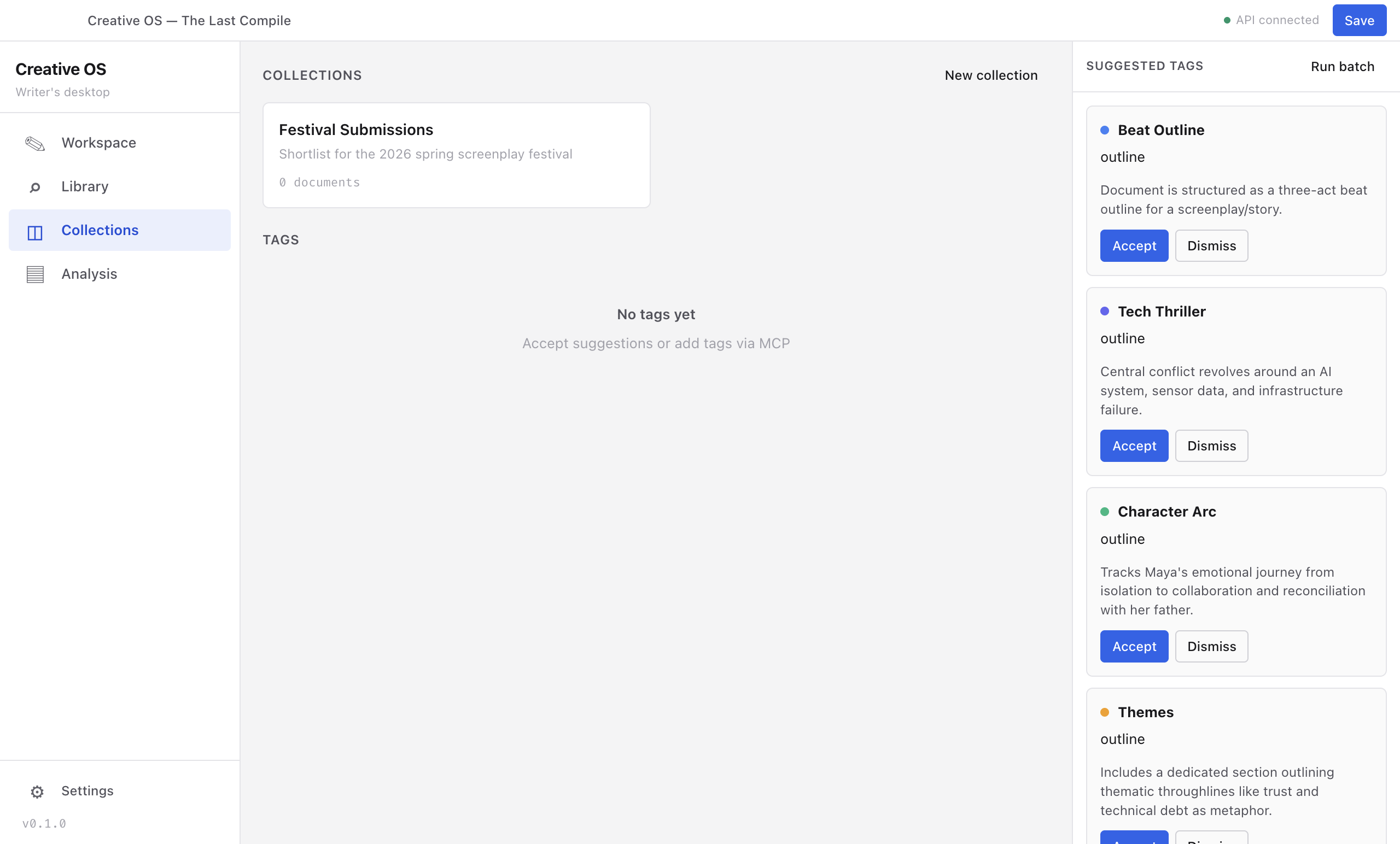
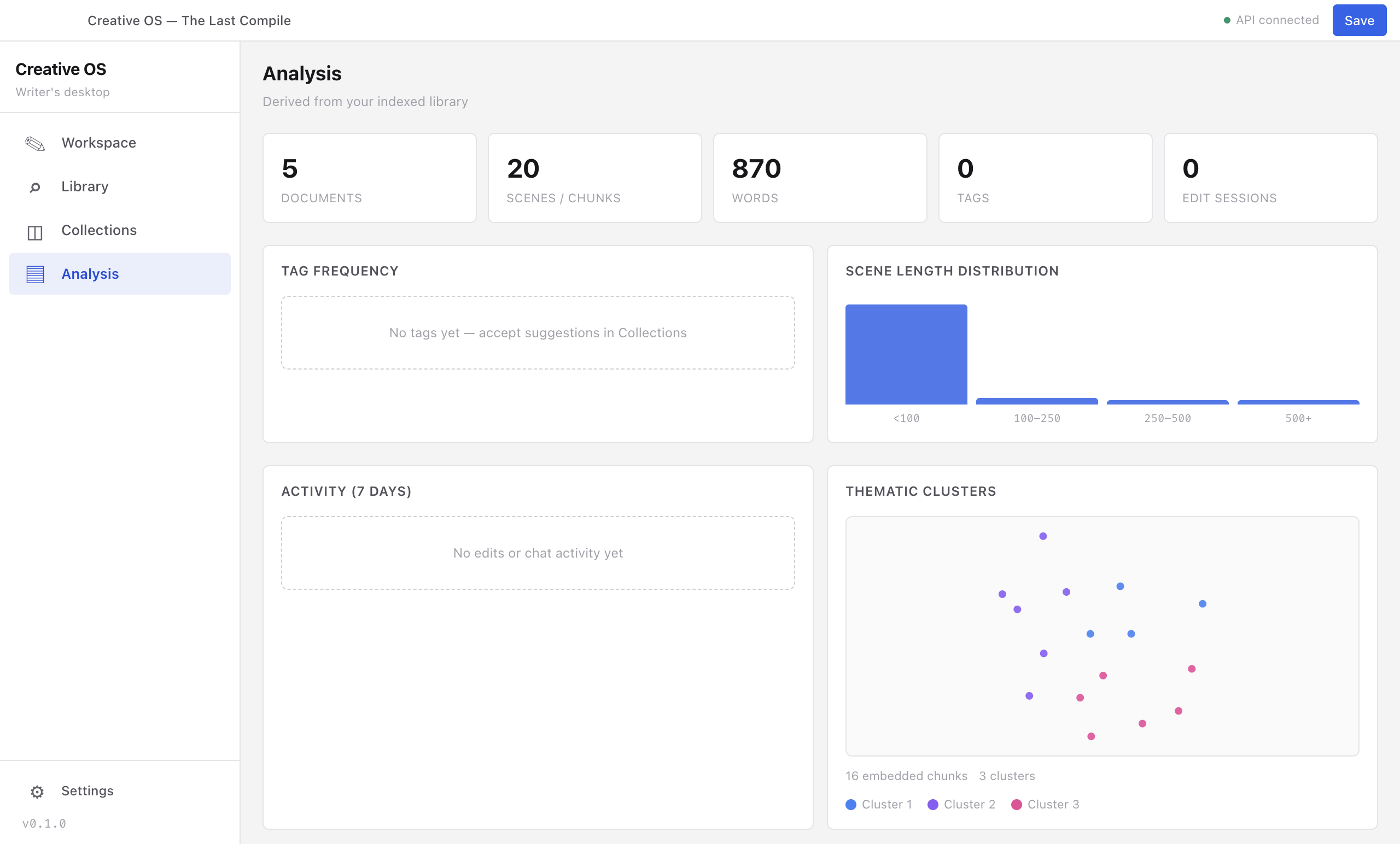
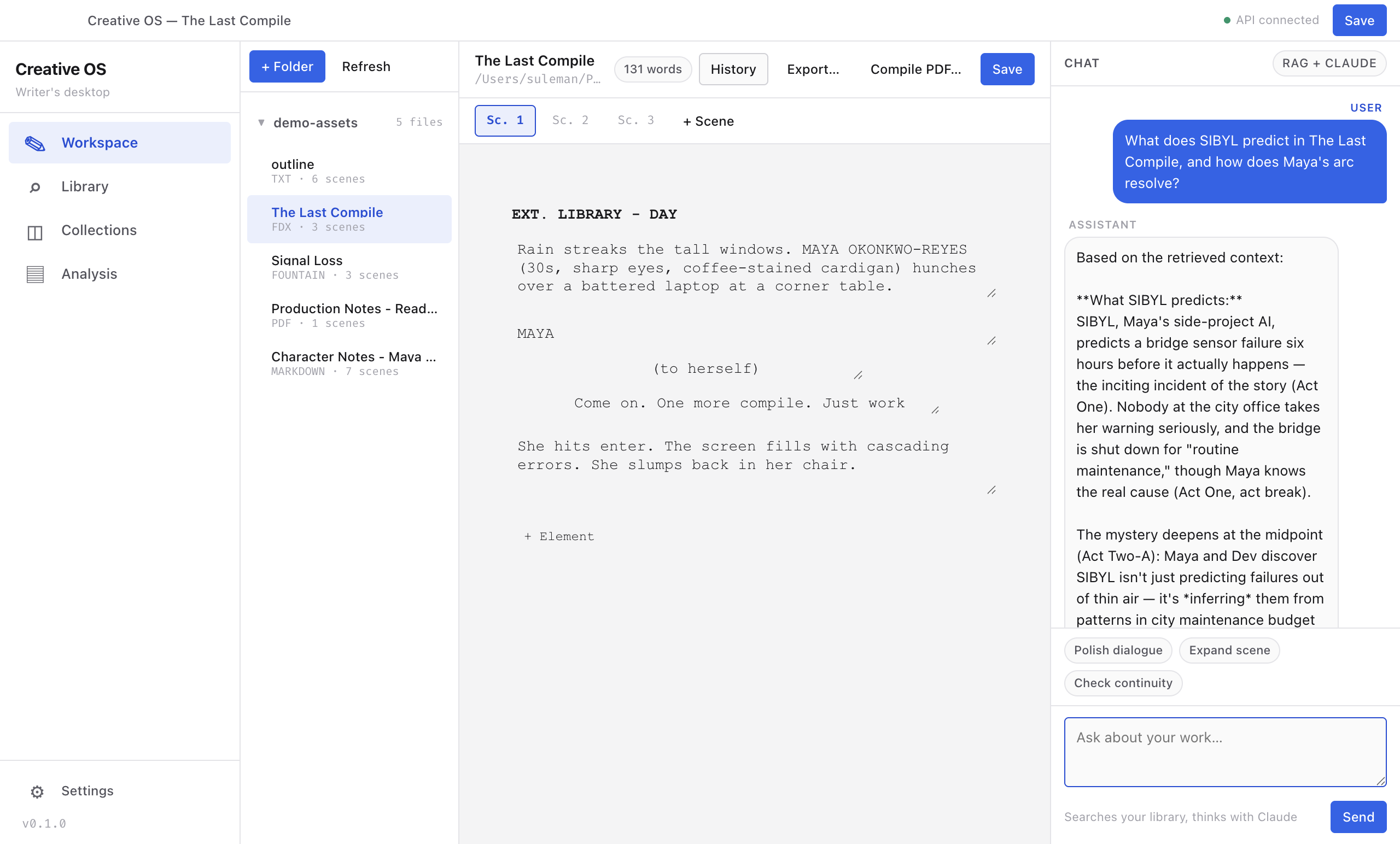
Final Draft (.FDX) files get native support — scenes, dialogue, characters, action blocks, and transitions are parsed directly, so AI-assisted edits happen without breaking the original screenplay formatting. Multi-document semantic search lets Claude reason across scripts, notes, research, and lyrics simultaneously rather than one file at a time, combining information from multiple sources into a single, context-aware answer. AI-powered auto-tagging organizes a growing library into searchable collections by theme, genre, character, and topic, and an analysis dashboard gives creators visibility into indexed content, AI activity, and writing progress.
An MCP server architecture keeps the tool ecosystem extensible, so new capabilities can reach indexed content and external tools through a typed protocol without touching the core app. That matters for a product built on a fast-moving AI landscape — writers get a tool that can grow new integrations over time instead of being locked into one fixed set of AI capabilities at launch.
- Challenge
- Writers, filmmakers, musicians, and other creators wanted AI assistance across screenplays, lyrics, and notes — for many, script drafts, lyrics, and story notes are sensitive material they don't want touching a third-party server before it's ready. Typical AI chatbots compound the problem: they can't reach into a creator's local files at all, and they lose context the moment a conversation ends, forcing every new session to start from zero instead of building on accumulated work. At the same time, creators didn't want to be locked into one fixed set of AI tools or a single vendor's ecosystem, since the AI landscape moves fast and a rigid integration risks going stale. Any solution also needed to make sense of a large, unstructured local library — screenplays in Final Draft format, scattered PDFs, lyrics, notes, outlines, shot lists, and research documents — well enough to search across all of it at once and answer questions grounded in a creator's own material, not just store it.
- Solution
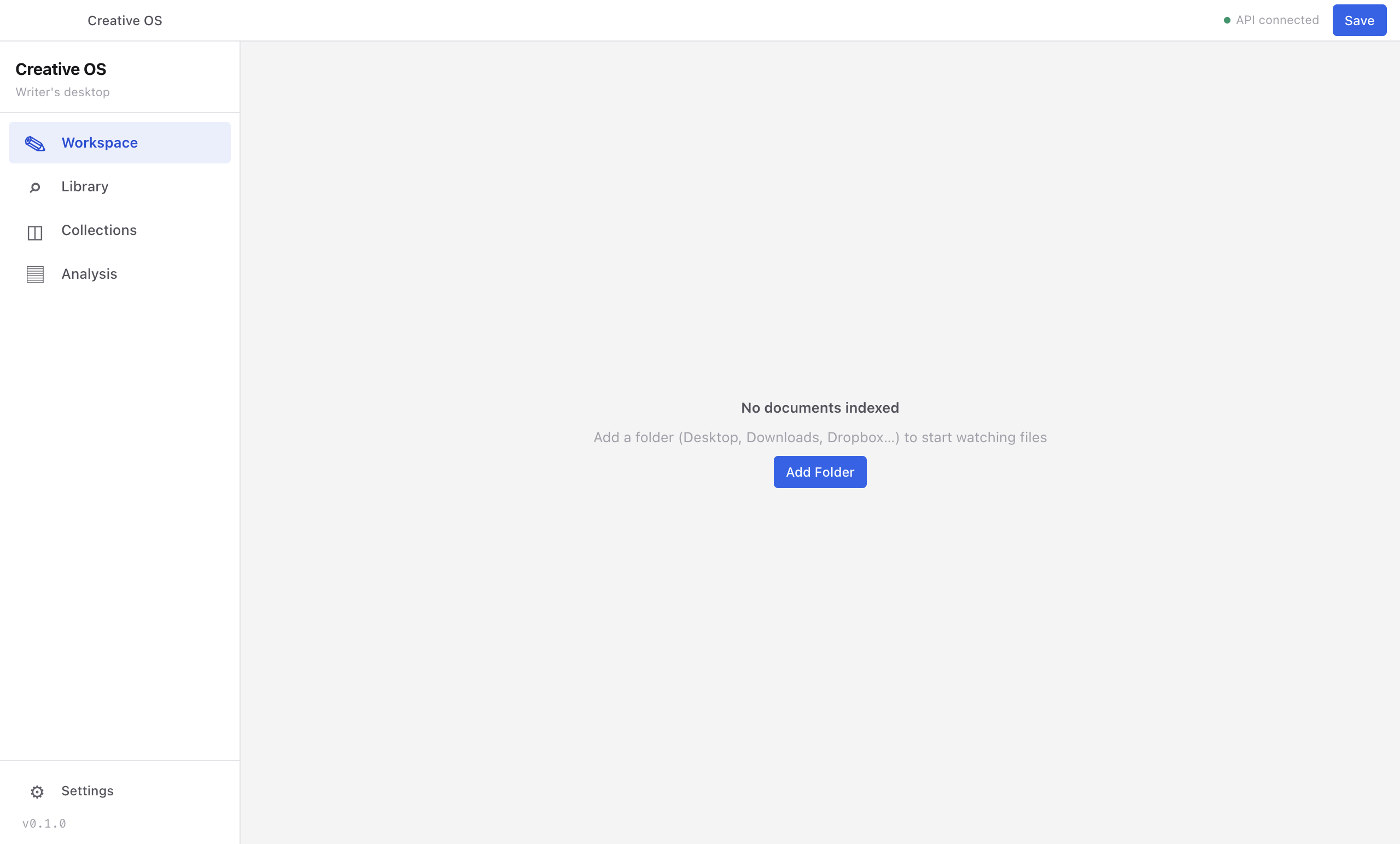
- Rather than acting as a traditional chatbot, Creative OS functions as an intelligent operating system for creative work — persistent, indexed knowledge that Claude can search, reason over, and edit directly, instead of a stateless conversation that forgets everything once it ends. Built as a local-first Electron/React desktop app, it indexes Final Draft screenplays, PDFs, lyrics, notes, outlines, shot lists, and research documents through a RAG pipeline running on ChromaDB and SQLite entirely on the user's machine, so nothing leaves local storage. That indexed context feeds Claude for semantic search, rewriting, and creative ideation, letting writers ask questions across their own material and get grounded answers instead of generic suggestions — including reasoning across scripts, notes, research, and lyrics simultaneously rather than one document at a time. Final Draft (.FDX) files get native support: scenes, dialogue, characters, action blocks, and transitions are parsed directly so AI-assisted edits happen without breaking the original screenplay formatting. AI-powered auto-tagging generates themes, genres, characters, and topic tags automatically, organizing everything into searchable collections, with an analysis dashboard surfacing indexed content stats, AI activity, and writing progress. An extensible MCP server architecture sits behind the app, giving Claude a typed protocol to reach indexed content and external tools — new capabilities can be added to that ecosystem without touching the core app.
- Impact
- Gave writers, filmmakers, and musicians AI-powered editing, search, and organization that never leaves their machine, addressing both the confidentiality and short-term memory limits generic cloud-based chatbots couldn't solve — indexed context persists across sessions instead of resetting with every new conversation. Auto-tagging and collections keep a growing local library organized without manual upkeep, and the analysis dashboard gives creators visibility into their own project's activity and progress. The MCP-based architecture means the tool ecosystem around the app can keep growing — new integrations, new capabilities — without requiring changes to the core application itself, keeping the product from going stale as the AI tooling landscape evolves.
Frequently Asked Questions
Writers, filmmakers, musicians, and other creators wanted AI assistance across screenplays, lyrics, and notes, but typical AI chatbots can't reach into local files or hold onto creative context over time — and sending unfinished creative work to the cloud, or being locked into one fixed set of AI tools, wasn't an option either.
Creative OS was built with Electron, React, TypeScript, RAG, ChromaDB, SQLite, MCP, Claude API.
This was built as commercial/client work, so the source code isn't publicly available. Get in touch to discuss the implementation.
Typical chatbots can't reach into local files and lose all context the moment a conversation ends. Creative OS instead functions as an operating system for creative work — it indexes a creator's entire local library and keeps that context persistent, so Claude builds on accumulated material across sessions instead of starting from zero each time.
Final Draft (.FDX) screenplays, PDFs, lyrics, notes, outlines, shot lists, and research documents — all indexed locally through its RAG pipeline.
Yes — it natively parses scenes, dialogue, characters, action blocks, and transitions, so AI-assisted edits happen without breaking the original screenplay formatting.
Yes — multi-document semantic search lets Claude reason across scripts, notes, research, and lyrics simultaneously, combining information from multiple sources into one context-aware answer.
AI-powered auto-tagging generates themes, genres, characters, and topic tags automatically, organizing assets into searchable collections, with an analysis dashboard surfacing indexed content stats, AI activity, and writing progress.
Available for work
Got a project like this
in mind?
Let's talk about what you're building and how I can help ship it.